Every project gets two dates
Most projects carry a single date: the day the thing ships. That one date is doing two separate jobs, and when it slips you can’t tell which of the two actually failed.
So we give every project two dates instead.
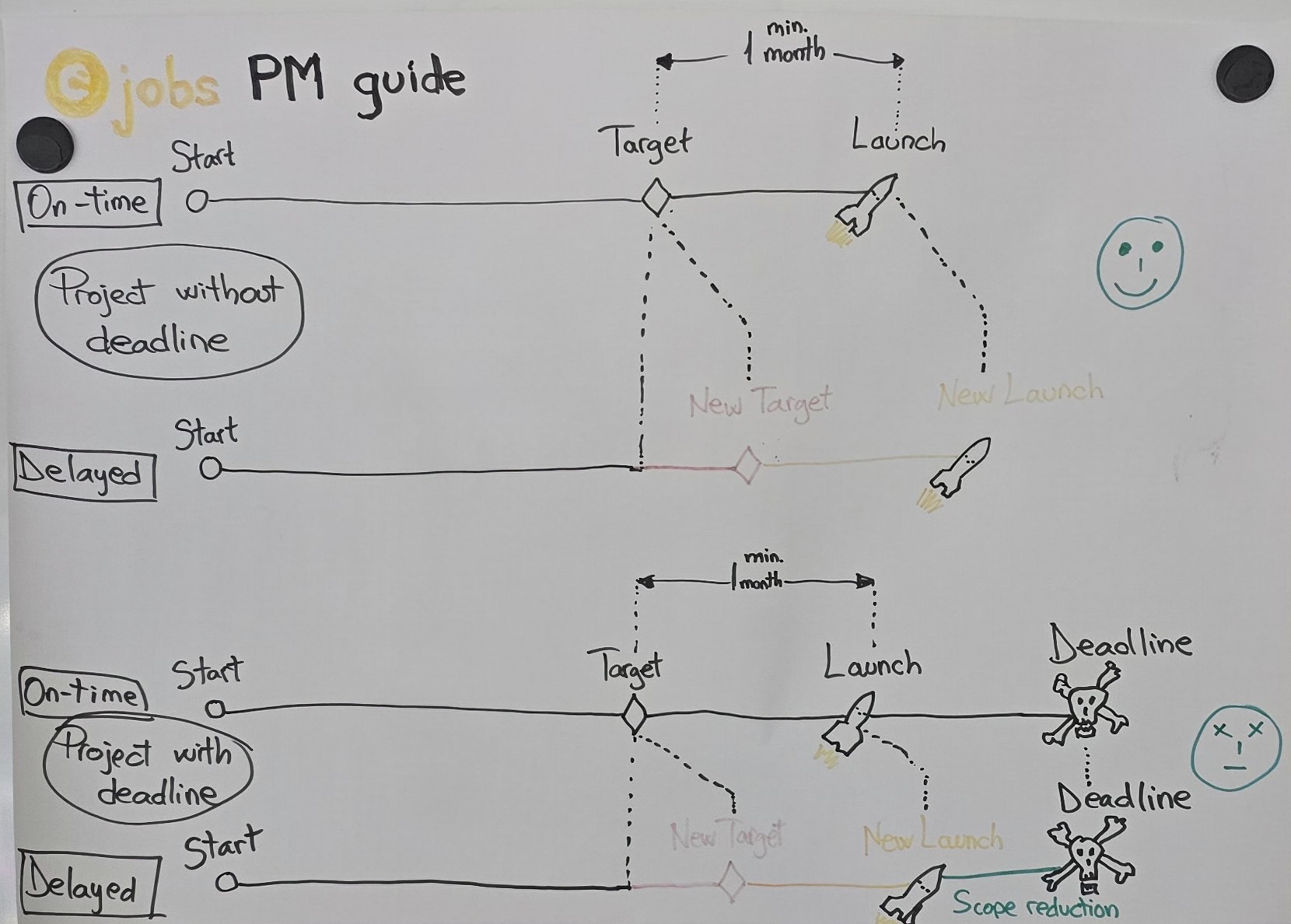
Target is when the work is meant to be finished. Launch is when it goes out to users. There is a minimum of one month between them, and that month is not padding. It’s the piece that makes the rest of it work.
When it slips
It will slip. Deriving the Target from recorded history rather than from somebody’s guess makes it slip less, but nothing makes it stop.
The rule is that Target and Launch move together, and the month between them survives the move. You get a New Target and a New Launch, still a month apart.
The instinct when a project runs late is to hold Launch and squeeze the gap, because the gap looks like slack and slack looks like the obvious thing to spend. It’s the opposite. The gap is the only reason a late project can still launch safely. Spend it and you’ve kept the date by making the launch worse, which is a trade nobody would agree to if you said it out loud.
Projects without a deadline
Everything shifts right. The Target moves, the Launch moves, the month holds. It costs you time and nothing else.
That’s the whole story for most of what we build, and it’s why a project without an external deadline is a fundamentally more comfortable thing to run.
Projects with a deadline
Now the same slip has nowhere to go. The shift runs into a date somebody else set, and no amount of moving things right will help you.
At that point there is exactly one lever left, and it’s scope. Something planned doesn’t get built. You can decide that deliberately, early, while there’s still a choice about which parts go, or you can discover it in the last week when the choice makes itself.
The point
A deadline doesn’t make a project faster. It converts delay into lost scope. That’s the trade, and it’s worth being honest about it at the start, because the alternative is agreeing to a deadline as if it were free and then paying for it in features you never told anyone you were dropping.
Originally published in January 2019. The server it lived on is gone, so this is rebuilt from memory.